
High Natural Moisture
Fresh mint contains substantial moisture, making it highly perishable and vulnerable to rapid wilting, microbial deterioration and loss of texture.
Learn how commercial freeze drying can help preserve the natural green colour, refreshing aroma, delicate structure and functional value of mint leaves for premium food, beverage, herbal and ingredient applications.
Mint is valued for its vibrant appearance, refreshing fragrance and versatile use across beverages, seasonings, herbal formulations, ready-to-eat foods, nutraceutical products and culinary preparations. However, freshly harvested mint begins losing moisture, colour and aroma soon after harvesting.
Conventional hot-air drying can extend storage life, but exposure to heat and oxygen may result in leaf shrinkage, darkening and the loss of delicate volatile compounds. Freeze drying offers a gentler alternative by removing frozen moisture under vacuum through sublimation.
When the process and packaging are properly controlled, freeze-dried mint can maintain a more recognisable leaf structure, lighter texture and fresher-looking appearance than many conventional drying methods. This makes it suitable for premium retail products as well as commercial ingredient supply.
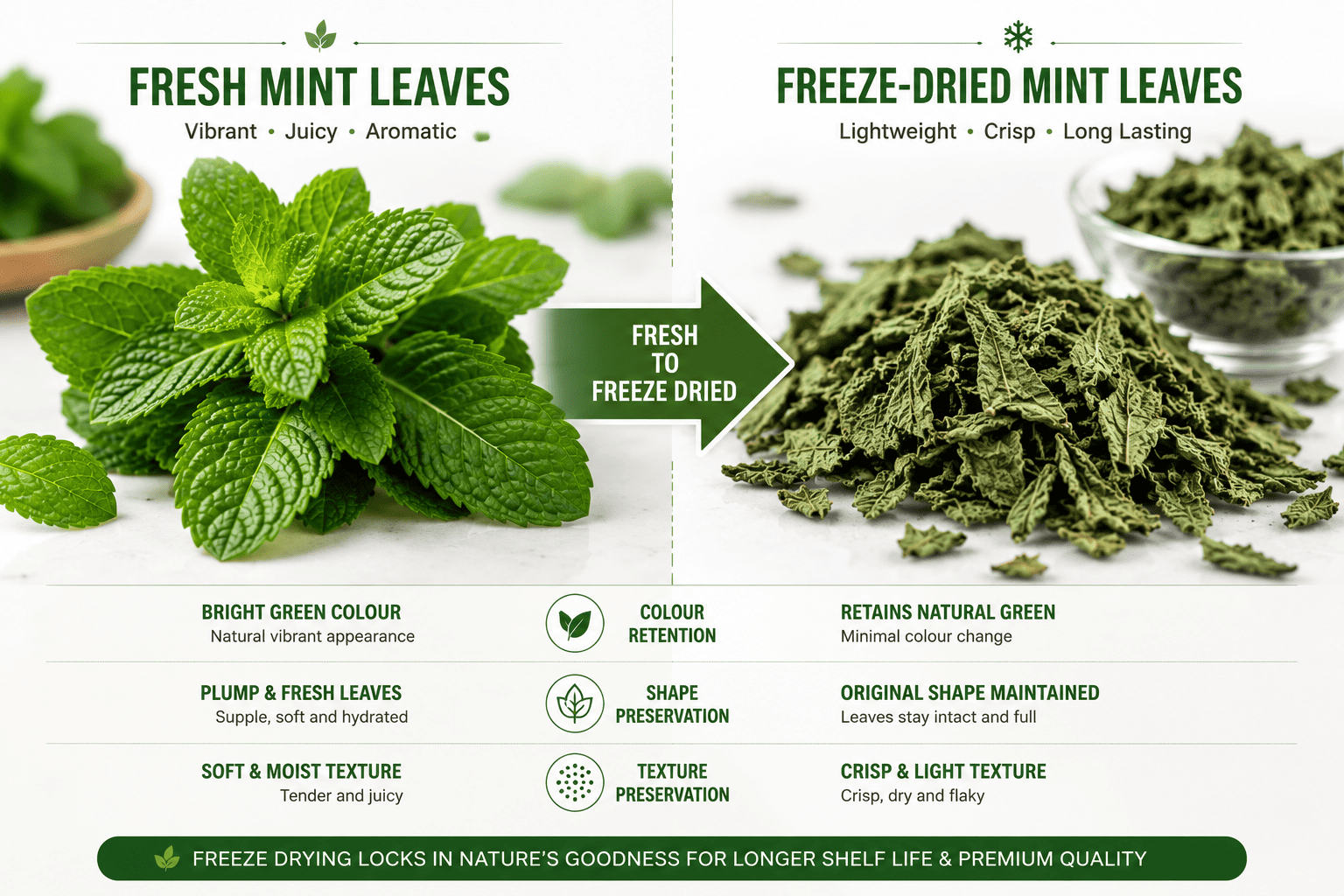
Mint is a delicate leafy material. Its market value depends heavily on colour, aroma and visual quality, yet these characteristics can deteriorate rapidly after harvesting and during unsuitable drying or storage.
Fresh mint contains substantial moisture, making it highly perishable and vulnerable to rapid wilting, microbial deterioration and loss of texture.
Heat, oxygen and prolonged processing can cause the bright green colour to become dull, brownish or olive, reducing visual appeal.
Mint’s characteristic fragrance comes from volatile compounds that can diminish when exposed to high temperatures or excessive processing time.
Bruising, delayed processing and prolonged exposure to air can accelerate undesirable colour changes before the leaves are fully stabilised.
Mint leaves are thin and easily damaged. Aggressive handling, excessive compression or uneven tray loading can affect appearance and drying uniformity.
Freeze-dried leaves readily absorb atmospheric moisture. Delayed or inadequate packaging can soften the product and reduce storage stability.
Final quality depends on more than the freeze dryer alone. Harvest condition, washing, surface-water removal, tray loading, freezing rate, vacuum stability, shelf-temperature control and immediate moisture-barrier packaging all influence the finished product.
A controlled workflow helps protect the mint before, during and after drying. The exact cycle must be developed according to the variety, maturity, loading density, equipment configuration and desired final quality.
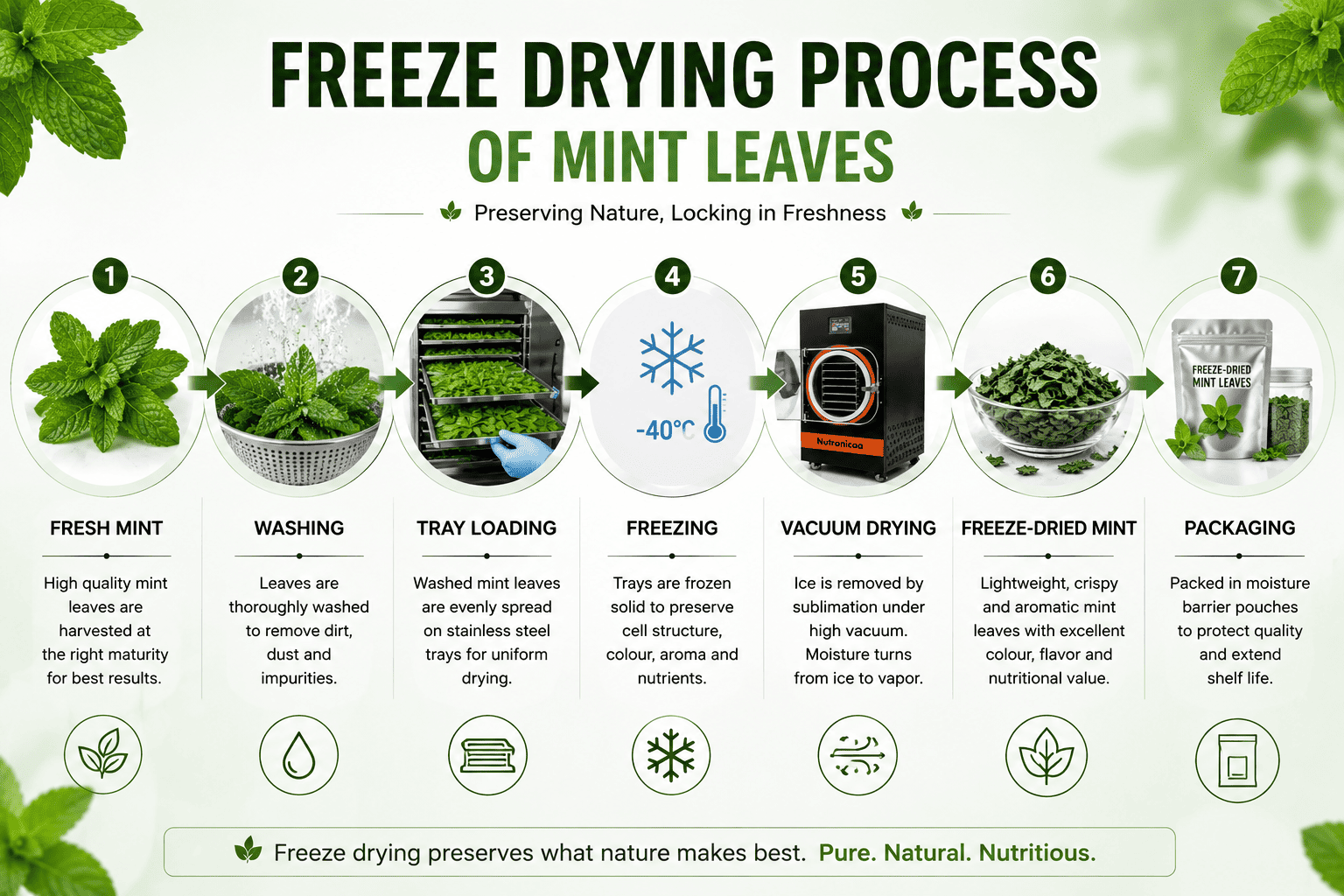
Select clean, healthy leaves with good colour and aroma.
Remove soil, dust and field contaminants using a controlled wash.
Spread leaves evenly without excessive compression or overloading.
Freeze the product thoroughly before initiating vacuum drying.
Under vacuum, frozen water is removed mainly through sublimation.
Controlled heating reduces residual bound moisture to the target level.
Pack promptly in suitable moisture- and oxygen-barrier packaging.
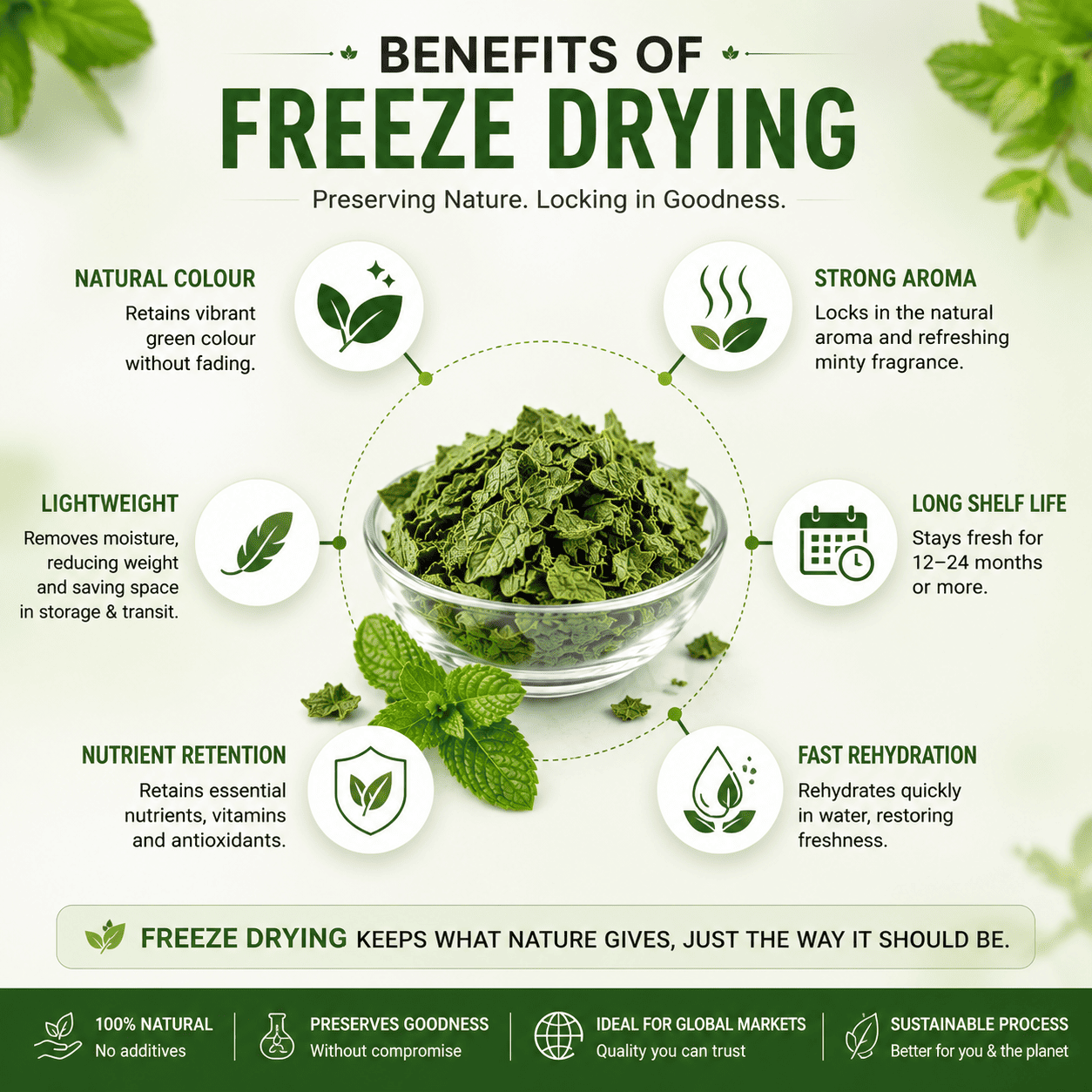
Compared with high-temperature drying methods, a well-controlled freeze-drying process can provide stronger retention of mint’s desirable sensory and structural characteristics. The actual outcome depends on raw-material quality, process settings and packaging.
Low-temperature processing can help reduce the severe darkening associated with aggressive heat drying.
Reduced exposure to high heat can help protect more of mint’s volatile aromatic character.
Properly dried and protected mint can remain stable far longer than fresh leaves when stored correctly.
The porous structure allows the product to absorb water more readily than many dense, heat-dried materials.
Gentle processing can support improved retention of selected heat-sensitive and sensory characteristics.
Removal of most product moisture reduces weight, which can benefit storage, handling and transportation.
Explore Nutronicaaa freeze-drying solutions designed for herbs, fruits, vegetables, ready-to-eat foods and other value-added products.
Freeze-dried mint can be sold as whole leaves, crushed flakes, powder or a blended ingredient. Its lightweight structure, recognisable appearance and concentrated sensory profile make it suitable for premium food, beverage, wellness and ingredient markets.

Whole or lightly crushed leaves can be incorporated into herbal teas, wellness blends, digestive infusions and premium beverage formulations.
Mint flakes and powder can be used in seasoning mixes, chutney powders, snack coatings, spice blends and culinary preparations.
Fast rehydration supports use in instant noodles, soup mixes, ready meals, dehydrated sauces, rice preparations and convenience foods.
Processed mint powder may be considered for selected herbal formulations, capsules, wellness blends and functional ingredient products.
Bulk mint can be supplied to food manufacturers, cloud kitchens, seasoning companies, tea brands, bakeries and institutional buyers.
Restaurants and catering businesses can use freeze-dried mint where fresh herbs are unavailable, seasonal or difficult to store.
Premium pouches, jars and culinary packs can be marketed through online stores, speciality retailers, modern trade and direct-to-consumer brands.
Lightweight, shelf-stable mint can be supplied to international ingredient buyers, provided applicable food-safety and destination-market requirements are met.
Mint’s refreshing sensory profile is associated with volatile aromatic compounds. These compounds can evaporate, oxidise or chemically change when leaves are exposed to high temperatures, prolonged drying time, strong airflow and repeated contact with oxygen.
During conventional drying, the leaf surface may heat considerably before moisture has been fully removed. As water migrates outward, aroma compounds may escape along with the moisture vapour. Excessive heat can also damage leaf pigments and create a cooked or hay-like sensory character.
Heat accelerates the evaporation and degradation of sensitive volatile compounds.
Oxygen can contribute to oxidation, colour loss and changes in sensory quality.
Continuous hot airflow may carry away volatile aroma components during drying.
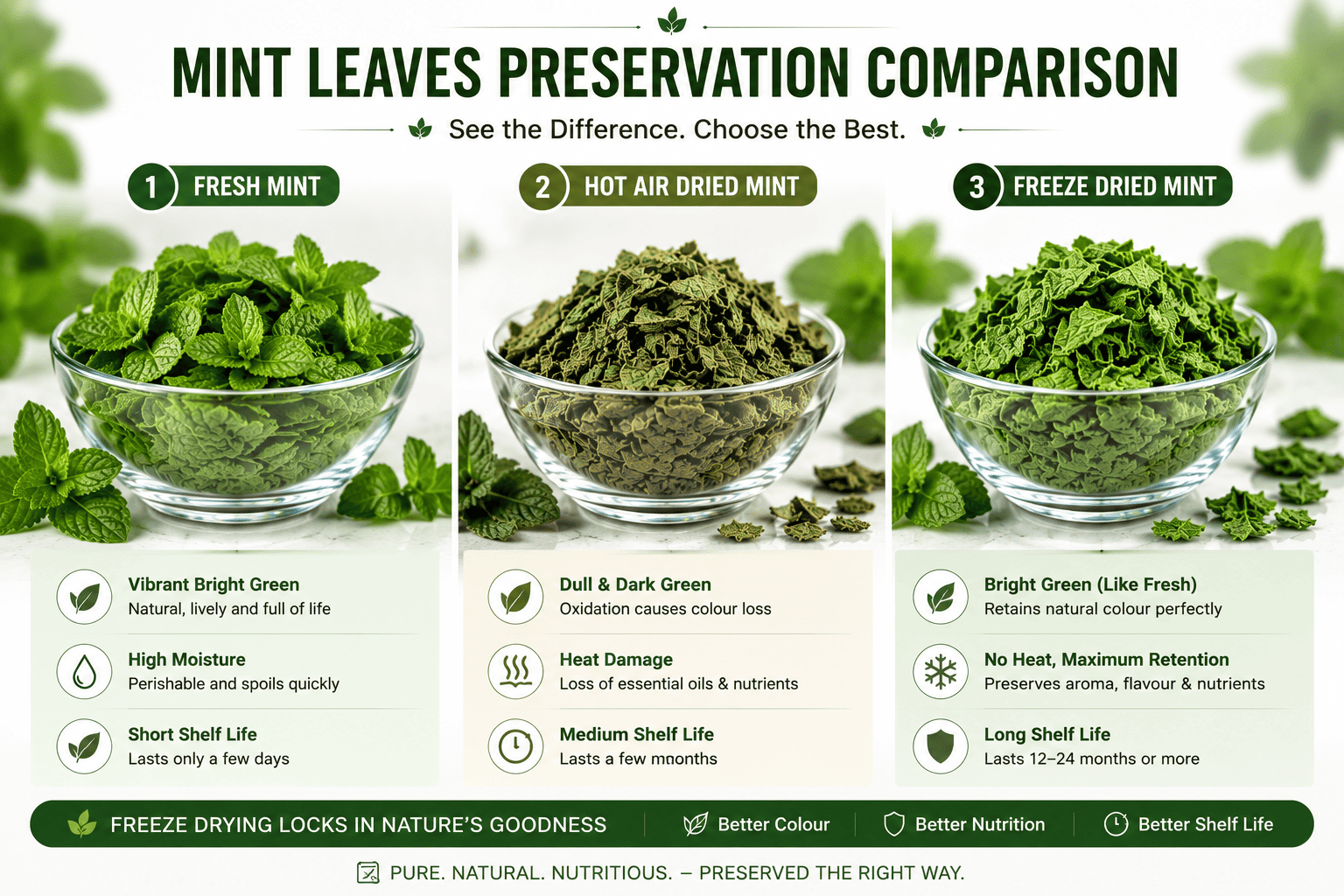
Both technologies can produce commercially useful ingredients, but the resulting appearance, structure, process cost and target market may differ considerably. The most suitable method depends on the required product quality and selling price.
| Comparison Factor | Fresh Mint | Hot-Air-Dried Mint | Freeze-Dried Mint |
|---|---|---|---|
| Typical Positioning |
Fresh Produce Local and immediate consumption. |
Standard Ingredient Economical seasoning and powder markets. |
Premium Ingredient High-value food, beverage and retail markets. |
| Processing Principle | No drying process. | Moisture is removed using heated air. | Frozen moisture is removed mainly by sublimation under vacuum. |
| Colour Retention | Bright initially, but deteriorates rapidly during storage. | May become darker, duller or olive depending on temperature and exposure. | Can retain a fresher-looking green appearance when processed correctly. |
| Aroma Retention | Strong when freshly harvested. | Some volatile aroma may be lost through heating and airflow. | Lower thermal exposure can support improved aroma retention. |
| Leaf Structure | Soft, hydrated and flexible. | Often shrunken, dense or brittle. | Typically porous, lightweight and recognisable. |
| Rehydration | Not applicable. | Can rehydrate slowly or incompletely. | Porous structure generally supports faster rehydration. |
| Storage Potential | Short without refrigeration. | Extended when properly dried and packaged. | Extended when residual moisture, water activity and packaging are controlled. |
| Production Cost | Low processing cost but high perishability and cold-chain dependence. | Lower capital and energy cost than freeze drying. | Higher equipment and cycle cost, requiring premium market positioning. |
| Best-Suited Market | Fresh retail, restaurants and local distribution. | Mass-market seasonings, powders and commodity ingredients. | Premium retail, export, functional ingredients and high-value formulations. |
Commercial note: Freeze drying is not automatically the best option for every market. It is most suitable where improved quality retention, product differentiation and premium pricing can justify the higher production cost.
Freeze-dried mint is highly porous and can absorb moisture rapidly from the surrounding air. Correct packaging is therefore an essential part of the process—not an optional step after drying.
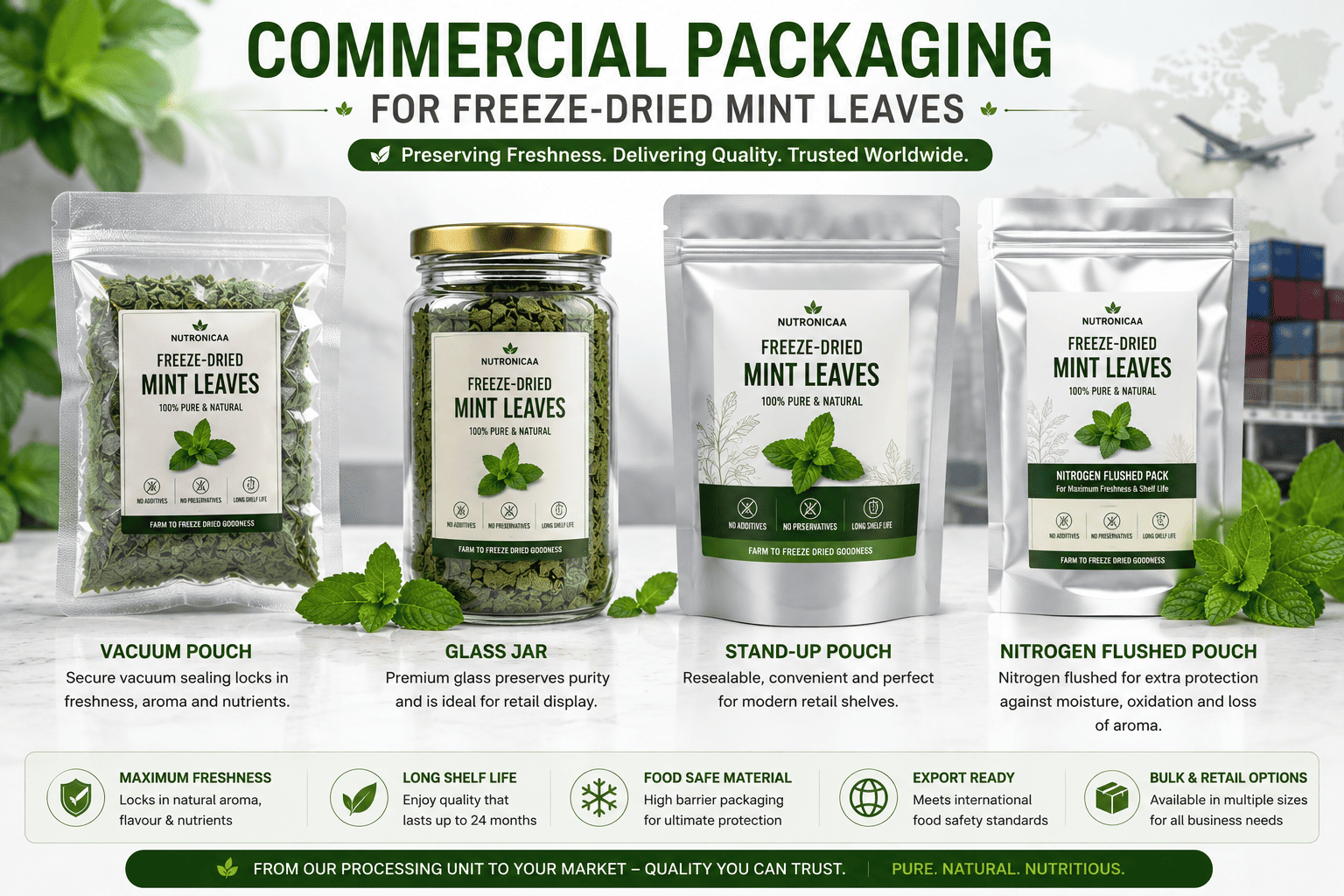
Vacuum sealing removes a substantial portion of the package air and can be useful for bulk packs or products requiring compact storage.
Bulk and B2B SupplyLaminated pouches with good moisture and oxygen barriers are suitable for retail packs, provided the seal integrity is reliable.
Retail and E-CommercePremium jars offer product visibility and shelf appeal but must use moisture-resistant closures and appropriate inner seals.
Premium RetailNitrogen flushing can reduce oxygen exposure and may support quality protection for premium packaged ingredients.
Export and Premium BrandsUse food-grade, high-barrier packaging with validated sealing performance. Minimise the time between cycle completion and packing. Depending on the product, pack size and market, oxygen absorbers or desiccants may be considered after appropriate food-safety and package-compatibility evaluation. Store finished packs away from heat, sunlight and humidity.
A premium machine cannot compensate for poor raw material or improper handling. Commercial quality is created by controlling the complete chain from harvest to packaging.
Variety, growing conditions and harvest maturity influence leaf colour, aroma intensity, texture and final product quality.
Long delays can cause wilting, respiration losses, enzymatic changes and aroma deterioration before freezing begins.
Mint should be cleaned without excessive bruising. Free surface water should be reduced before tray loading to avoid unnecessary ice load.
Overlapping or densely packed leaves may restrict vapour movement and create uneven drying within the batch.
The mint must be sufficiently frozen before vacuum drying. Incomplete freezing may increase the risk of structural collapse or melt-back.
Stable vacuum and an adequately cold condenser are essential for effective sublimation and reliable vapour capture.
Controlled shelf heating supplies energy for drying without allowing the product temperature to rise beyond its safe processing limit.
Cycle completion should be assessed through validated process indicators, product temperature and suitable final moisture or water-activity testing.
Exposure to humid air after drying can rapidly reduce crispness and stability, even when the freeze-drying cycle was successful.
Consistent herb processing requires more than simply reaching a low temperature. The refrigeration, vacuum, condenser, shelf-heating and automation systems must operate together throughout the complete cycle.
Freeze drying can convert a seasonal and perishable herb into a lightweight, differentiated ingredient. Commercial success, however, depends on disciplined sourcing, validated processing, compliant packaging and access to buyers who value premium quality.

Sell mint leaves, tea blends, seasoning flakes or powder through your own website, marketplaces, speciality stores and modern retail.
Supply food manufacturers, tea brands, seasoning producers, restaurants, nutraceutical companies and ready-meal processors.
Process and pack products for wellness brands, food startups and retailers that do not operate their own freeze-drying facilities.
Target importers and ingredient distributors seeking shelf-stable herbs, subject to food-safety, documentation and destination-market requirements.
Combine mint with lemon, tulsi, ginger, moringa or other ingredients to create tea blends, seasoning mixes and wellness products.
Process customer-owned herbs on a batch-service basis after establishing suitable quality, traceability and commercial controls.
Start with controlled trials and a clearly defined target market before investing in large production volumes.
Freeze-dried mint’s low weight, reduced perishability and premium positioning can support international ingredient and retail opportunities. Export readiness requires more than a long shelf life: buyers may require defined microbiological, pesticide-residue, traceability, packaging, labelling and documentation standards.
Businesses should confirm the requirements of the destination country and buyer before production. Product testing, batch records and packaging validation help build confidence with professional importers.
Nutronicaaa commercial freeze dryers combine controlled refrigeration, vacuum drying, heated shelves and programmable operation for food, herb and value-added ingredient applications.
Commercial herb processing requires coordinated refrigeration, vacuum generation, condenser performance, shelf heating and programmable cycle control. Nutronicaaa freeze dryers are developed to support food processors, startups, research facilities and commercial producers seeking reliable freeze-drying capability.
The refrigeration system supports low-temperature operation required for product freezing and moisture capture during the freeze-drying process.
Programmable controls help operators organise freezing, primary drying and secondary drying stages for repeatable product-specific recipes.
Heated shelves provide controlled energy during drying, helping moisture leave the product while the selected process limits are maintained.
Vacuum performance is an important part of sublimation. The system allows operators to monitor the process and identify abnormal operating conditions.
The operator interface provides convenient access to temperatures, cycle stages, process settings and machine operating information.
Indian manufacturing supports easier technical communication, machine customisation, spare-part planning and long-term service coordination.
Nutronicaaa freeze dryers are developed with an understanding of Indian operating conditions, commercial production needs and the importance of accessible local engineering support.
Yes. Fresh mint leaves can be freeze dried after suitable sorting, washing, draining, tray loading and freezing. The leaves should be healthy, clean and processed as soon as practical after harvesting to reduce wilting and aroma loss.
Freeze drying can provide better colour retention than aggressive high-temperature drying because the product experiences less thermal stress. However, final colour also depends on raw-material quality, harvest condition, preparation, oxygen exposure, cycle control and packaging.
A well-controlled low-temperature freeze-drying process can support improved aroma retention compared with prolonged hot-air exposure. Some aroma loss can still occur during harvesting, washing, processing, grinding, storage or repeated package opening.
Mint intended for food use should undergo an appropriate cleaning process. Washing must be performed hygienically without excessive bruising. Surface water should be adequately drained or removed before loading because excess water increases the ice load and can lengthen the drying cycle.
This depends on the intended product. Premium whole-leaf products generally benefit from removing thick or damaged stems. Fine stems may be retained for powder or seasoning applications after confirming that they do not negatively affect flavour, appearance or drying uniformity.
There is no single temperature suitable for every machine and batch. The cycle includes freezing, primary drying and secondary drying, each with different operating requirements. Settings should be validated for the mint variety, tray loading, machine design, target moisture and required product quality.
Drying time varies according to leaf quantity, loading density, surface water, freezing performance, vacuum level, condenser capacity, shelf-temperature programme and the required final moisture. Commercial cycle time should be established through actual trials rather than a fixed universal estimate.
Leaves should be distributed evenly in a controlled layer without heavy compression. Excessive overlapping can restrict vapour movement and create uneven drying. Consistent loading between batches also helps improve process repeatability.
Visual crispness alone is not always sufficient. Commercial producers should use validated cycle indicators, product-temperature behaviour and suitable final moisture or water-activity testing. Samples from different tray positions may be checked during process validation.
Freeze-dried mint has a porous structure and readily absorbs moisture from humid air. It can lose crispness quickly if left exposed. The pack should be resealed immediately, and commercial products should use suitable moisture-barrier packaging.
Food-grade, high-barrier laminated pouches are commonly suitable for commercial packs. Vacuum sealing, nitrogen flushing, oxygen absorbers or desiccants may be considered according to the product and validated packaging system. Seal strength and resistance to moisture and oxygen are important selection factors.
Shelf life depends on residual moisture, water activity, microbial quality, oxygen exposure, package barrier, seal integrity and storage conditions. A commercial shelf-life claim should be supported by product-specific testing rather than a general estimate.
Yes. Properly dried mint can be milled into flakes or powder for seasonings, beverage mixes, soups, chutney powders and selected herbal products. Grinding increases exposed surface area, so the powder should be packed promptly and protected from moisture, heat and oxygen.
Profitability depends on raw-material cost, fresh-to-dry yield, batch loading, electricity, labour, packaging, marketing, machine utilisation and selling price. Freeze-dried mint generally needs premium positioning rather than commodity pricing to justify its higher processing cost.
Evaluate usable tray area, realistic mint loading, condenser performance, vacuum-pump capacity, shelf heating, sensor accuracy, programmable control, electrical requirements, service support and intended production frequency. Select capacity according to validated batch loading rather than machine dimensions alone.
Explore additional guides covering freeze-drying technology, equipment selection, food applications and commercial planning.
Our next planned commercial herb guide will cover freeze drying moringa leaves, including preparation, drying considerations, powder production, packaging and business applications.
This commercial guide has been prepared by Lab Solution India as part of its Freeze-Drying Knowledge Centre. It combines general freeze-drying principles with practical considerations relevant to herb preparation, equipment selection, commercial production and packaging.
Actual freeze-drying parameters must be established through product trials using the selected machine, mint variety, tray loading and quality target. Businesses should independently validate food safety, product stability, regulatory compliance and shelf-life claims before commercial sale.
Explore commercial freeze-drying systems developed for mint, moringa, coriander, tulsi, curry leaves, fruits, vegetables, ready-to-eat foods and other value-added products.
No account yet?
Create an Account