
High Natural Moisture
Fresh leaves contain substantial moisture, making them vulnerable to wilting, microbial deterioration and rapid post-harvest quality loss.
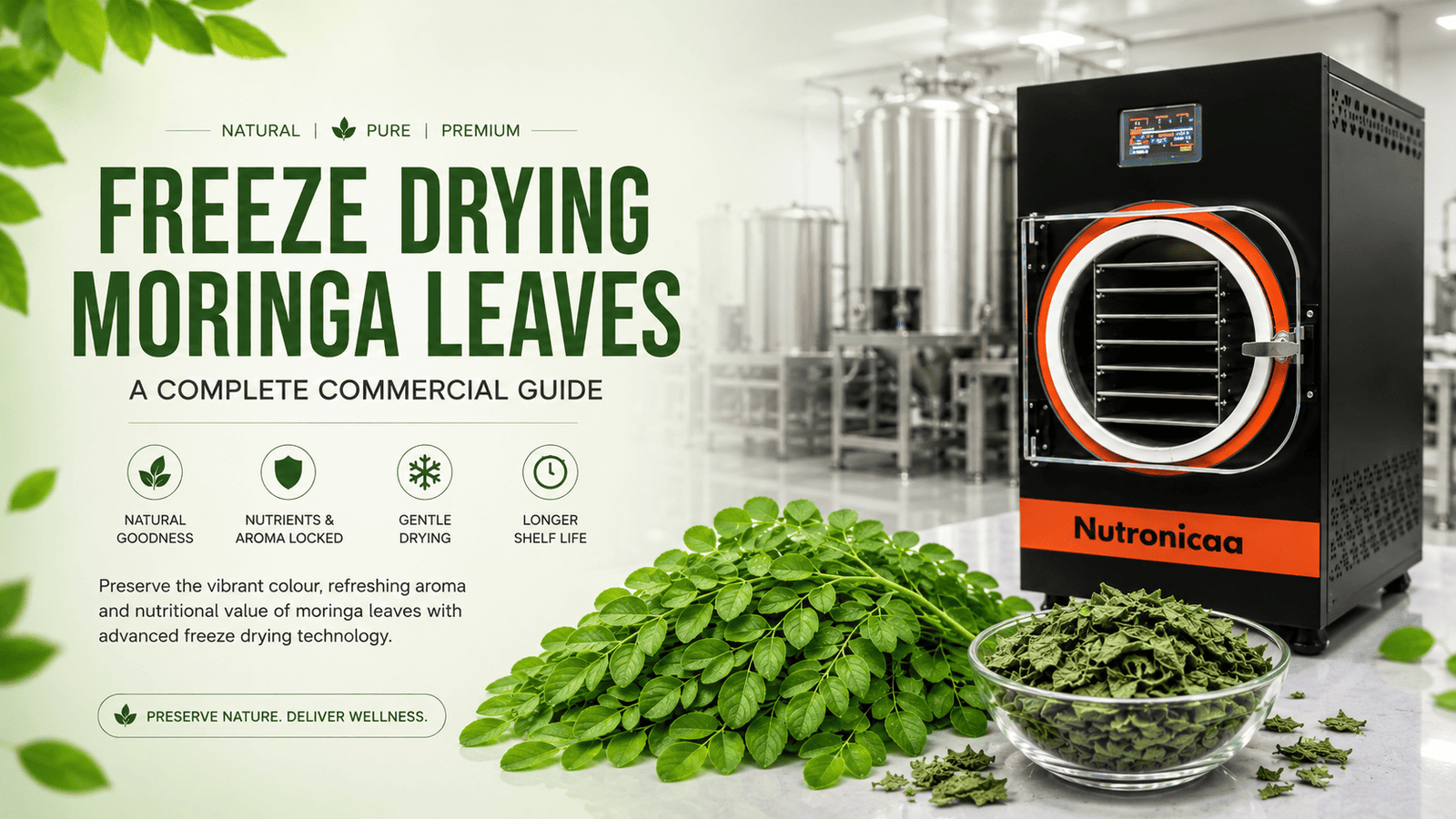
Learn how commercial freeze drying can help preserve the natural green colour, delicate structure, nutritional value and market potential of moringa leaves for nutraceutical, food, wellness and export applications.
Moringa leaves are widely used in health foods, herbal formulations, dietary supplements, functional beverages, tea blends and natural ingredient products. Their commercial value is closely linked to their green appearance, nutritional composition and clean botanical identity.
Fresh moringa leaves are highly perishable. After harvesting, they can rapidly lose moisture, colour and freshness. Conventional drying can extend storage life, but excessive heat and oxygen exposure may reduce the quality of heat-sensitive compounds and darken the finished material.
Freeze drying removes frozen water under vacuum through sublimation. When supported by proper raw-material preparation, controlled shelf heating and suitable packaging, the process can produce lightweight moringa leaves with a porous structure and premium market positioning.
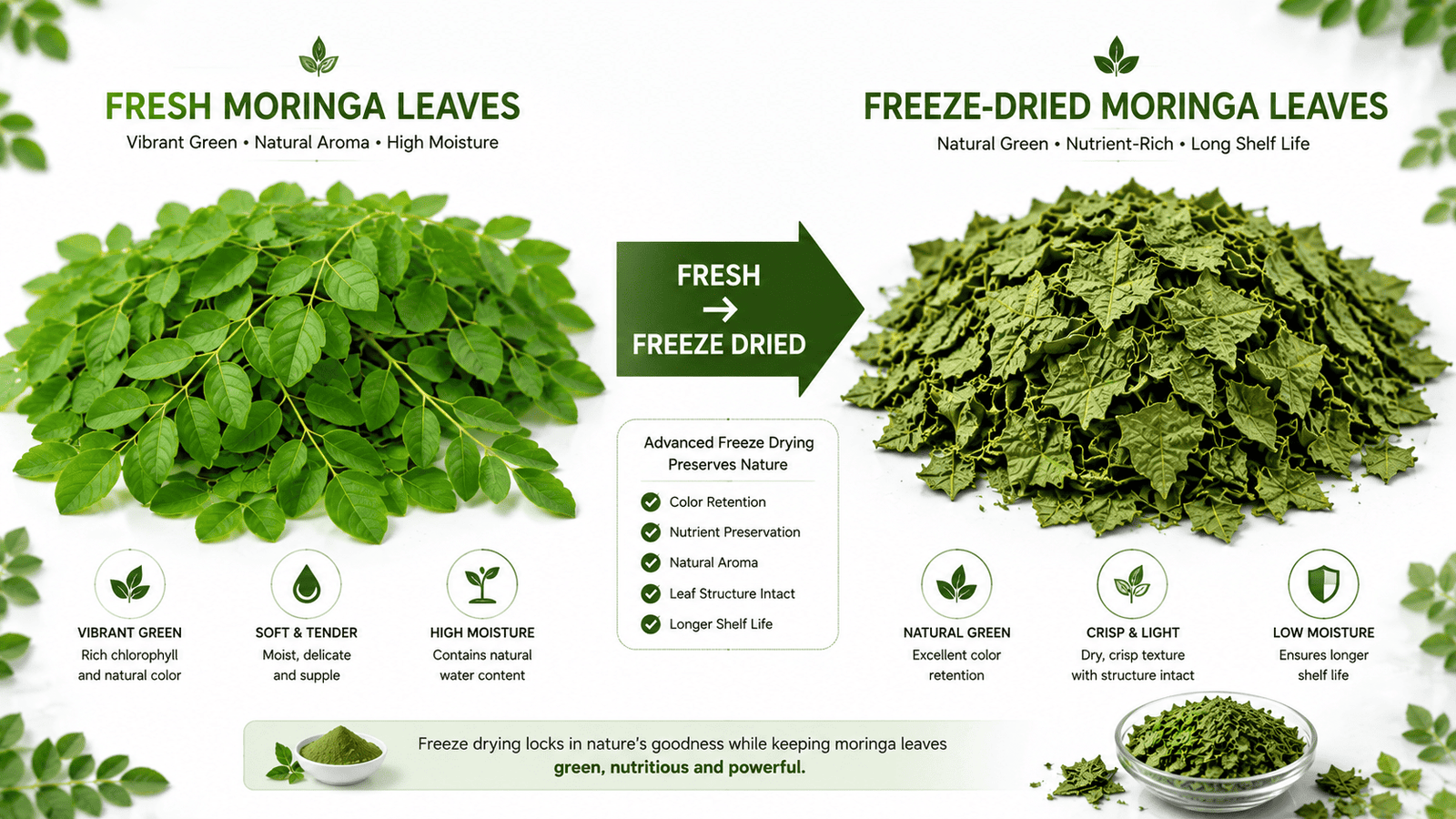
Moringa leaves are delicate biological materials. Their quality can decline quickly after harvesting, particularly when handling, temperature, airflow or storage conditions are unsuitable.
Fresh leaves contain substantial moisture, making them vulnerable to wilting, microbial deterioration and rapid post-harvest quality loss.
Heat, oxygen and prolonged exposure can turn bright green leaves dull, brownish or olive, reducing visual appeal.
Some vitamins, pigments and plant compounds may be affected by high processing temperatures and long drying exposure.
Delayed processing and damaged leaves can accelerate undesirable colour and sensory changes before drying begins.
Thin leaves are easily bruised or compacted. Excessive overlap can also cause uneven drying and inconsistent batch quality.
Freeze-dried moringa is porous and can absorb atmospheric moisture rapidly if packaging is delayed or unsuitable.
Final product quality depends on the entire processing chain: harvest timing, sorting, washing, surface-water removal, tray loading, freezing, vacuum stability, shelf-temperature control, drying endpoint and immediate moisture-barrier packaging.
A disciplined process helps minimise quality loss before drying and supports consistent moisture removal during the cycle. Exact parameters should be validated for the selected moringa variety, equipment and final product format.
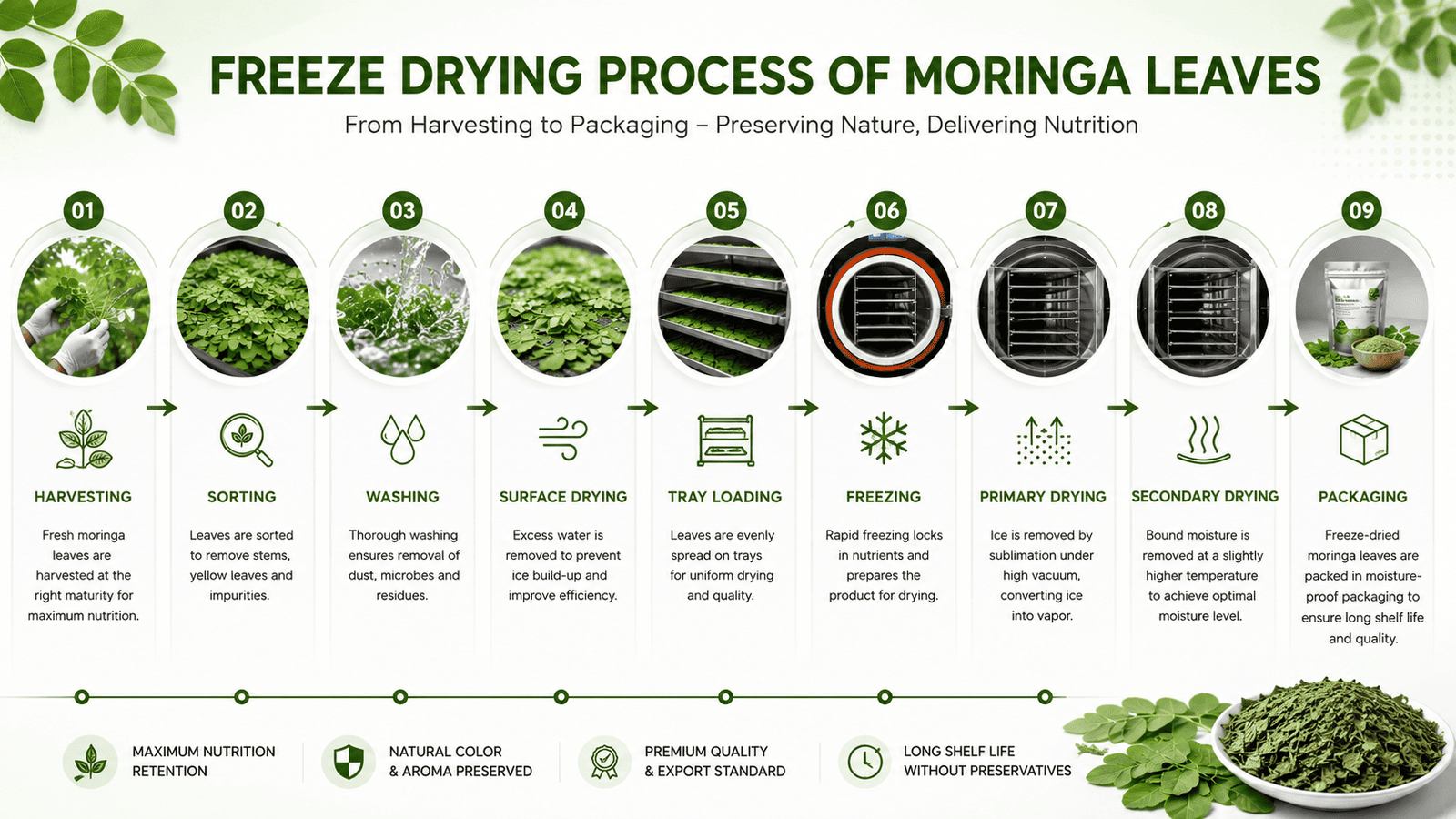
Select healthy leaves at suitable maturity and process them promptly.
Remove yellow, damaged or contaminated leaves and thick unwanted stems.
Clean the leaves hygienically without excessive bruising or rough handling.
Reduce free water before loading to avoid unnecessary ice and cycle load.
Spread leaves evenly without dense compression or excessive overlapping.
Freeze the product thoroughly before starting vacuum drying.
Frozen water leaves mainly through sublimation under controlled vacuum.
Controlled heating reduces residual bound moisture toward the target level.
Pack immediately in suitable moisture- and oxygen-barrier packaging.
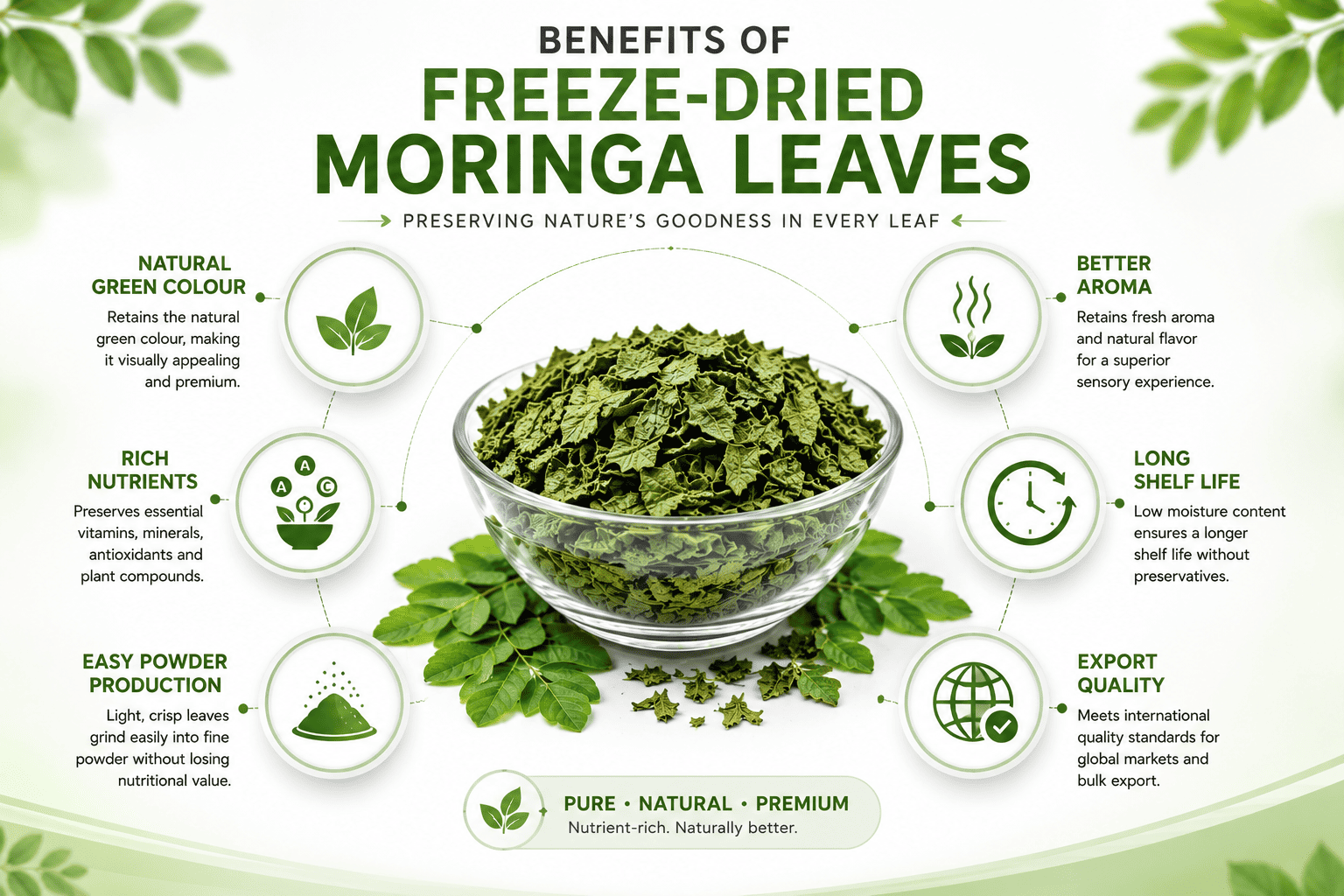
Freeze drying is selected for premium moringa products because it can reduce the thermal damage associated with aggressive hot-air processing. Results still depend on the quality of the raw leaves, validated cycle settings and packaging performance.
Lower-temperature processing can help reduce severe darkening and preserve a fresher-looking colour.
Gentle drying may support improved retention of selected heat-sensitive and sensory characteristics.
Reduced exposure to strong heat may help preserve more of the natural botanical aroma.
Proper drying and high-barrier packaging can provide substantially longer storage than fresh leaves.
Crisp, lightweight leaves can be milled into powder for food, beverage and supplement applications.
Lightweight and differentiated products may suit high-value B2B and export ingredient markets.
Explore Nutronicaaa freeze-drying solutions for moringa, herbs, fruits, vegetables, ready-to-eat foods and other value-added products.
Freeze-dried moringa can be sold as whole leaves, flakes, fine powder, capsules, tablets or a blended functional ingredient. Its commercial value depends on verified quality, hygienic processing, suitable packaging and accurate product claims.
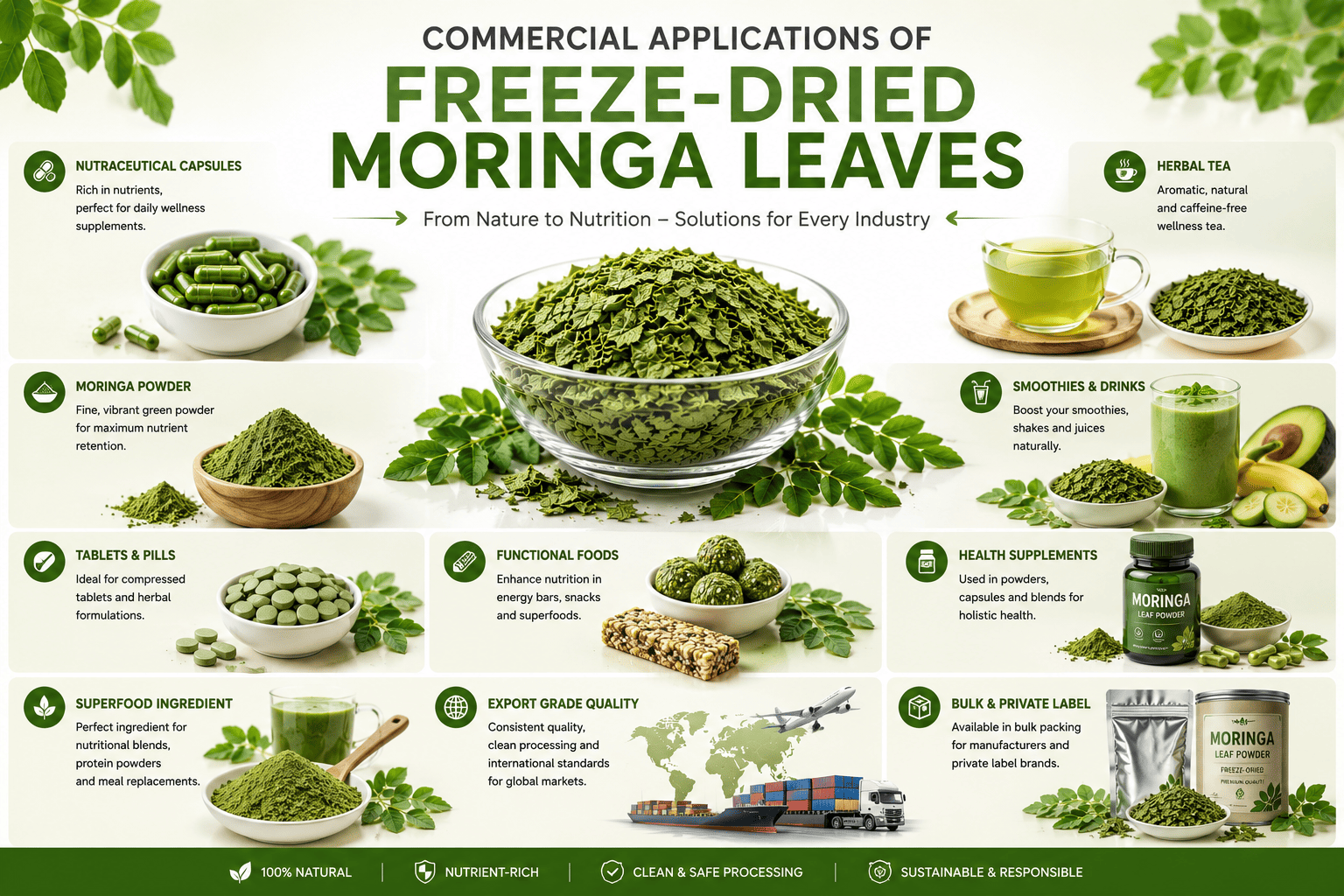
Moringa powder may be incorporated into suitable capsules, tablets and wellness formulations after product testing and regulatory review.
Whole or crushed moringa leaves can be combined with tulsi, mint, lemongrass, ginger or other botanicals for tea products.
Crisp freeze-dried leaves can be milled into a fine powder for premium health-food and functional ingredient products.
Moringa can be used in selected bars, mixes, beverages, soups, savoury foods and fortified products.
Bulk moringa leaves and powder can be supplied to food, wellness, beverage and botanical-product manufacturers.
Processors may manufacture and pack products for third-party wellness brands, retailers and distributors.
Premium pouches, jars, capsules and powder packs can be marketed through online stores and speciality retailers.
Properly documented moringa products may be supplied to overseas buyers after meeting destination-market requirements.
Conventional hot-air drying removes moisture by exposing moringa leaves to heated moving air. It is practical and economical, but excessive temperature or long drying time may alter the appearance, aroma and selected heat-sensitive components of the finished product.
The final result depends greatly on dryer temperature, airflow, bed thickness, leaf maturity, processing time and oxygen exposure. Poorly controlled drying can create dark, brittle or unevenly dried material.
Higher temperature can affect sensitive pigments, aroma compounds and selected nutrients.
Prolonged air exposure may contribute to colour darkening and changes in sensory quality.
Water loss under heat can create dense, shrunken or brittle leaves with slower rehydration.
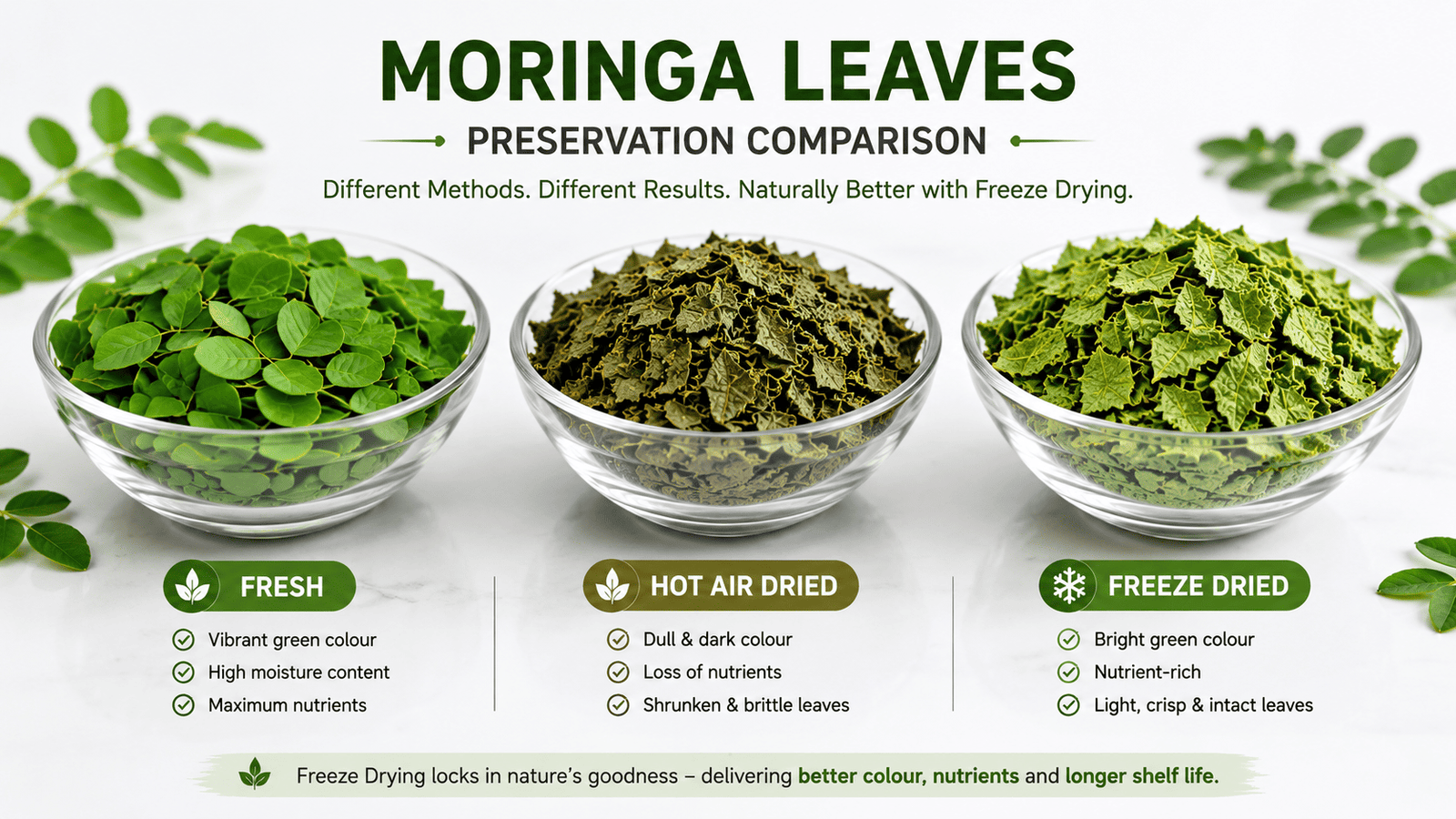
Each form serves a different market. Fresh moringa is highly perishable, hot-air-dried moringa is generally more economical, and freeze-dried moringa is best suited to premium applications where quality differentiation can justify higher processing costs.
| Comparison Factor | Fresh Moringa | Hot-Air-Dried Moringa | Freeze-Dried Moringa |
|---|---|---|---|
| Market Position | Fresh Produce | Standard Ingredient | Premium Ingredient |
| Colour | Bright initially but deteriorates rapidly. | May become darker or duller depending on heat exposure. | Can retain a fresher-looking green colour when properly processed. |
| Structure | Soft, flexible and hydrated. | Often shrunken, dense or brittle. | Porous, lightweight and more recognisable. |
| Heat Exposure | No drying heat. | Moderate to high depending on the process. | Lower-temperature sublimation during primary drying. |
| Powder Quality | Requires drying before milling. | Economical powder for standard markets. | Suitable for premium powder positioning. |
| Storage Potential | Short unless refrigerated. | Extended with correct drying and packaging. | Extended when moisture, oxygen and packaging are controlled. |
| Processing Cost | Low processing cost but high perishability. | Lower equipment and energy cost. | Higher equipment and cycle cost. |
| Suitable Market | Fresh retail and local foodservice. | Commodity powder and general ingredients. | Premium retail, nutraceutical, B2B and export segments. |
Commercial note: Freeze drying should be selected when the customer values premium product characteristics and is willing to pay for the additional processing cost.
Moringa is commonly sold as a powder. The drying method used before milling influences colour, texture, market positioning and production cost.
A practical choice for high-volume and price-sensitive markets, provided drying temperature, hygiene and final moisture are properly controlled.
Designed for premium products where appearance, controlled processing and differentiated quality support a higher-value market position.
Freeze-dried moringa is porous and moisture-sensitive. Immediate packing in a suitable high-barrier system helps protect crispness, colour and storage stability.
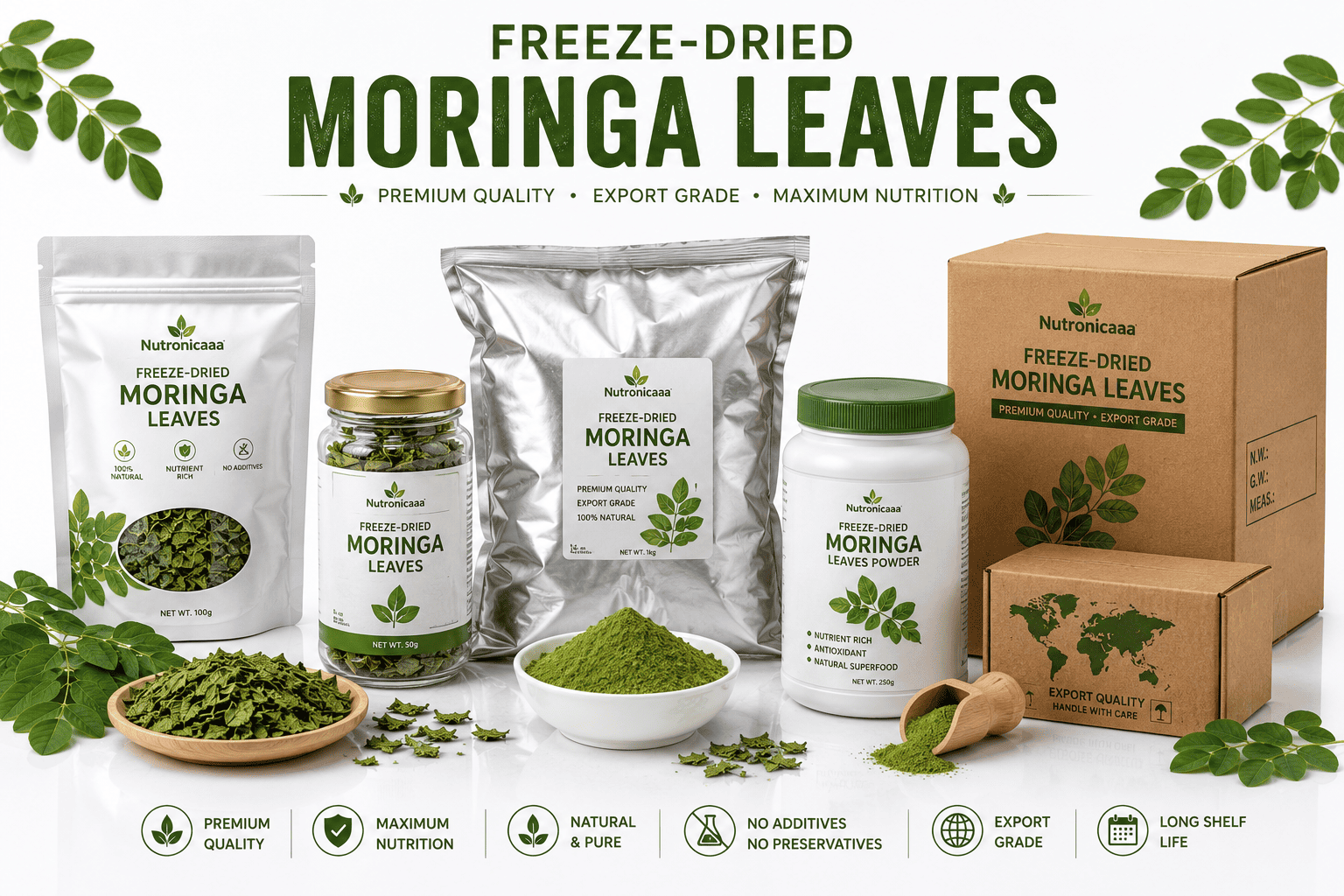
Suitable for retail leaves and powder when the laminate and seals provide reliable moisture and oxygen protection.
Retail and E-CommerceUseful for premium powder or whole-leaf packs when fitted with suitable closures and inner seals.
Premium Consumer PacksHigh-barrier bulk bags are suitable for B2B ingredient supply and contract manufacturing applications.
Bulk and Private LabelInner packs should be protected by strong outer cartons suitable for handling, stacking and transportation.
Export DistributionConfirm food-grade suitability, moisture barrier, oxygen barrier, seal integrity, pack strength and storage stability. Oxygen absorbers, desiccants, vacuum sealing or nitrogen flushing may be considered after product-specific validation.
The finished product reflects every stage of the process. High-quality equipment cannot fully compensate for poor leaves, unsuitable loading, delayed processing or inadequate packaging.
Variety, growing conditions and maturity influence colour, leaf thickness, flavour and powder characteristics.
Long delays can increase wilting, respiration losses and undesirable colour changes before freezing.
Leaves must be cleaned hygienically without excessive bruising or contamination during handling.
Excess free water increases ice load and may lengthen the freeze-drying cycle.
Thick or compact loading can restrict vapour flow and create uneven drying across the trays.
The leaves should be sufficiently frozen before vacuum drying to reduce the risk of collapse or melt-back.
Stable vacuum and suitable condenser temperature support effective sublimation and vapour capture.
Controlled heat input supports drying while avoiding excessive product temperature.
Final moisture or water activity and immediate sealed packaging should be validated for the intended product.
Commercial performance depends on the coordination of refrigeration, vacuum generation, condenser capacity, shelf heating, sensors and programmable control.
Freeze drying can convert fresh moringa into a premium ingredient, but commercial success depends on disciplined sourcing, validated processing, buyer requirements, packaging and realistic batch economics.
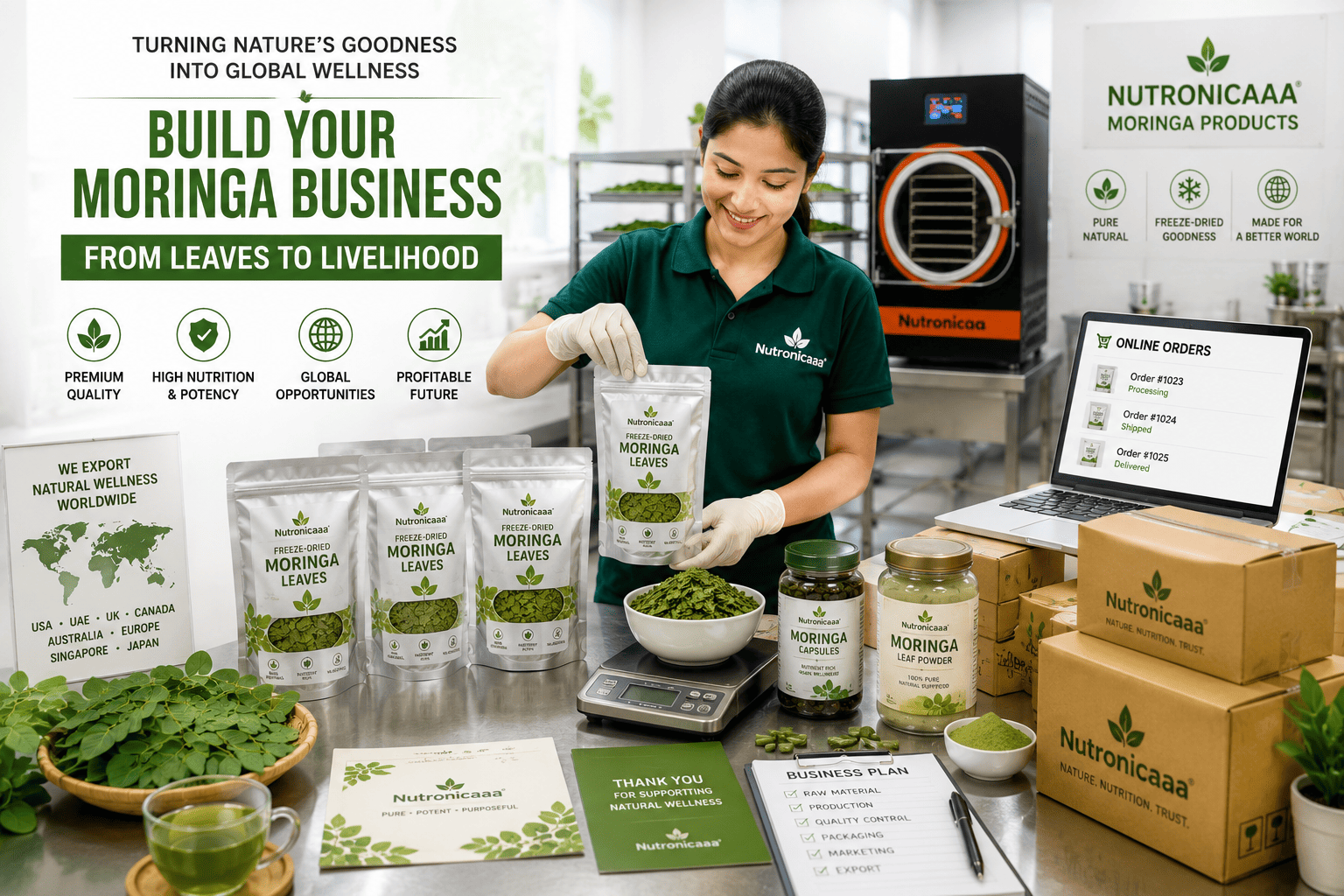
Sell leaves, powder, tea blends or related products through online channels and speciality stores.
Supply nutraceutical, food, tea, wellness and functional ingredient manufacturers.
Produce and pack moringa products for brands that outsource processing and packaging.
Supply importers and distributors after satisfying their quality, documentation and regulatory requirements.
Develop tea, powder, smoothie and wellness blends using moringa with other herbs or food ingredients.
Provide batch-processing services to growers and brands after establishing traceability and quality controls.
Validate the product and buyer before committing to large-scale capacity or extensive packaging inventory.
Freeze-dried moringa can be positioned as a premium botanical ingredient for overseas food, wellness and nutraceutical buyers. Export success depends on consistent batches and buyer-specific specifications rather than appearance alone.
Professional buyers may request microbiological testing, pesticide-residue limits, heavy-metal testing, traceability, ingredient declarations, packaging specifications and destination-market labelling compliance.
Nutronicaaa commercial freeze dryers combine refrigeration, vacuum drying, controlled shelf heating and programmable operation for herbs and value-added food products.
Freeze drying is a coordinated engineering process. Reliable output depends on refrigeration, vacuum generation, condenser performance, shelf heating, sensors and programmable controls working together through every phase of the cycle.
Nutronicaaa develops commercial freeze-drying systems for food entrepreneurs, herb processors, research facilities and value-added ingredient businesses. The focus is not only on achieving low temperature, but on providing a practical system for repeatable commercial production.
For moringa processors, equipment selection should consider usable tray area, real leaf-loading density, vacuum stability, condenser capacity, operating support and the ability to develop product-specific recipes.
Supports product freezing and low-temperature condenser operation throughout the freeze-drying cycle.
Designed for coordinated cycle performanceVacuum performance and chamber integrity support effective sublimation and consistent moisture removal.
Built around controlled drying conditionsProvides measured heat input during primary and secondary drying without relying on uncontrolled heating.
Supports product-specific recipe developmentGives operators access to temperatures, vacuum information, cycle stages and programmable settings.
Clearer operation and process visibilityOrganises freezing, primary drying and secondary drying stages for repeatable product-specific cycles.
Suitable for systematic batch improvementIndian manufacturing supports easier installation, communication, training, customisation and service planning.
Technical support closer to the customerNutronicaaa freeze dryers are developed for Indian operating conditions and commercial processing requirements, with local engineering communication and long-term service coordination.
Yes. Fresh moringa leaves can be freeze dried after suitable sorting, hygienic washing, surface-water removal, tray loading and complete freezing.
Prompt processing is important because delays after harvesting can lead to wilting, colour deterioration and declining raw-material quality.
Freeze drying uses lower product temperatures than many hot-air drying methods and may support improved retention of selected heat-sensitive compounds.
Actual nutrient retention depends on leaf quality, harvest maturity, preparation, oxygen exposure, cycle settings, milling and storage.
Freeze drying can provide a fresher-looking green appearance than aggressive high-temperature drying because the leaves experience less thermal stress.
Colour also depends on variety, maturity, leaf damage, processing delay, oxygen exposure and packaging.
Moringa intended for food or nutraceutical use should undergo a suitable hygienic cleaning process.
Washing should remove soil and field contamination without excessive bruising. Free surface water should be reduced before loading.
Thick stems, yellow leaves and damaged material are generally removed for premium whole-leaf and powder products.
Fine stems may be retained for some powder applications, but their effect on flavour, fibre, appearance and milling should be evaluated.
There is no universal temperature suitable for every machine and moringa batch.
Freezing, primary drying and secondary drying require different operating conditions. Settings should be validated according to loading, vacuum performance, equipment design and the required final quality.
Cycle duration depends on leaf quantity, surface water, loading depth, freezing performance, condenser capacity, vacuum level, shelf heating and target final moisture.
Commercial cycle time should be determined through trial batches and endpoint validation.
Spread moringa leaves in a reasonably uniform layer without excessive overlapping or compression.
Dense loading can restrict vapour movement and create uneven drying between the top, middle and lower portions of the tray.
Crispness is useful as an initial observation, but it may not confirm that every tray position has reached the required drying endpoint.
Commercial validation may include product-temperature behaviour, cycle data, representative samples and suitable final moisture or water-activity testing.
Freeze-dried moringa has a porous structure and can absorb moisture rapidly from humid air. This causes the leaves or powder to lose crispness and flowability.
Open packages only when necessary and reseal them promptly. Commercial packs require a suitable moisture barrier and dependable seal integrity.
Food-grade high-barrier laminated pouches are commonly used for whole leaves and powder. Rigid jars, bulk foil bags and suitable food-grade containers may also be selected.
The packaging system should be evaluated for moisture barrier, oxygen barrier, light protection, seal strength and compatibility with the intended shelf life.
Shelf life depends on residual moisture, water activity, microbial quality, oxidation, packaging barrier, sealing performance and storage temperature.
A commercial shelf-life claim should be supported by product-specific stability testing rather than a general estimate copied from another product.
Yes. Properly dried moringa leaves become crisp and can be milled into flakes or fine powder for food, beverage, wellness and ingredient applications.
Grinding increases exposed surface area, so the powder should be handled hygienically and packed promptly.
Yes, subject to applicable Indian export requirements, buyer specifications and destination-country regulations.
Buyers may require microbiological reports, pesticide residue testing, heavy-metal limits, traceability, ingredient declarations, compliant packaging and labelling.
Evaluate usable tray area, realistic leaf loading, refrigeration, condenser performance, vacuum-pump capability, heated shelves, sensors and programmable cycle control.
Installation requirements, operator training, technical support and spare-part availability should also be considered.
Explore practical guides covering herbs, freeze-drying technology, commercial equipment and business planning.
Product-specific guidance for premium herb preservation and value addition.
Learn about aroma retention, green colour, packaging, applications and mint business opportunities.
Read the mint guide →A planned commercial guide to colour, aroma, applications, packaging and process development.
Next in the seriesFuture guidance for botanical processing, aroma, tea applications and premium packaging.
Planned articleUnderstand the process, capacity and economics behind commercial freeze drying.
Understand freezing, sublimation, primary drying, secondary drying and vacuum operation.
Learn the process → SelectionCompare tray area, loading density, batch capacity and production requirements.
Select capacity → BusinessReview raw material, electricity, labour, packaging and utilisation costs.
Review economics →Explore freeze-drying systems and engineering support for value-added production.
Explore commercial systems for herbs, foods, ingredients and startup production.
Visit Nutronicaaa → ApplicationsReview commercial equipment considerations for leaves, botanicals and herbal ingredients.
Explore applications → Buying GuideUnderstand specifications, capacity and other factors affecting commercial equipment cost.
Read the buying guide →Practical information connecting products, process technology and commercial equipment.
The Freeze-Drying Knowledge Centre has been created by Lab Solution India to provide practical, engineering-focused information for businesses exploring commercial freeze drying.
Each guide explains the complete journey—from raw-material preparation and drying principles to packaging, equipment selection and market opportunities.
For businesses ready to implement commercial production, these educational resources connect naturally with Nutronicaaa, our Made-in-India freeze-dryer manufacturing and engineering brand.
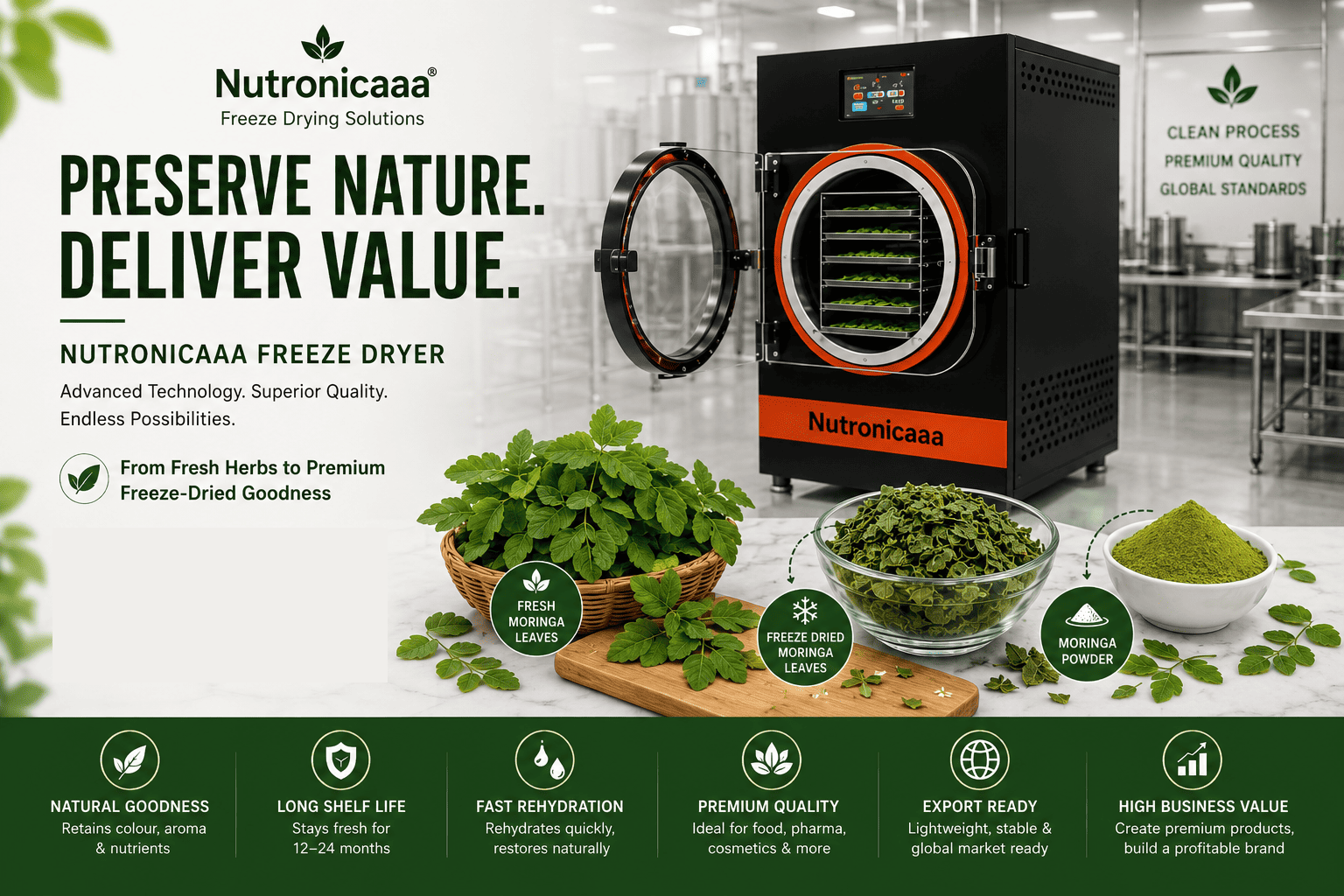
Explore Made-in-India commercial freeze dryers developed for moringa leaves, herbs, botanicals, fruits, vegetables, ready-to-eat foods and premium value-added products. Discuss your product, batch capacity and intended market with the Nutronicaaa engineering team.
Clear production requirements help the engineering team recommend a more suitable tray area, batch capacity and machine configuration.
No account yet?
Create an Account